Schaeffler and ThunderSoft sign deal to develop central vehicle computing platforms
 Petre Barac
Posted On May 12, 2026
Petre Barac
Posted On May 12, 2026
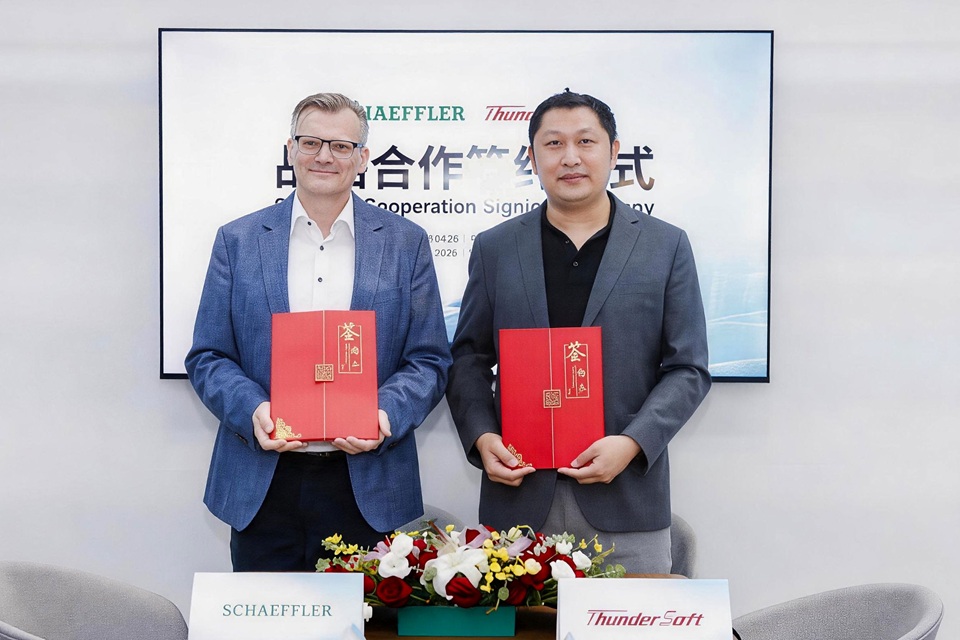
Schaeffler and ThunderSoft have announced a partnership to jointly develop and market central vehicle computing platforms for future vehicle architectures. The collaboration aims to support automotive manufacturers in their transition toward software- and AI-based vehicles. The partners focus on modular and scalable solutions that reduce development outlay and system complexity and pave the way for centralized software and data architectures.
“Central vehicle computers are developing into a key technology for software-defined vehicles,” says Thomas Stierle, CEO E Mobility at Schaeffler AG. “In addition to our in-depth automotive hardware and systems expertise, we are contributing our extensive software experience. Together with ThunderSoft’s software and platform expertise, we are creating scalable computing solutions, which consolidate safety-critical driving functions, driver assistance systems, and infotainment on a shared hardware basis.”
As the automotive industry transitions from traditional distributed electronic control unit (ECU) architectures to centralized vehicle computers, high performance computing platforms are gaining in importance. They enable multiple vehicle domains – such as powertrain, energy supply, driving functions, and infotainment – to be consolidated within a central processing unit. This forms the basis for flexibly scalable, data centric E/E architectures.
“Centralized computing platforms are becoming the cornerstone of intelligent vehicles,” says Xu Dongchao, Vice President of ThunderSoft Intelligent Automotive. “Through our collaboration with Schaeffler, we aim to accelerate innovation in software-defined vehicles and provide flexible, high-performance platforms for global deployment.”
As part of the cooperation, the two companies plan to develop fully integrated solutions for vehicle computer platforms that map functions from driver assistance, infotainment, and driving domains on a shared, flexible hardware basis. An initial regional focus will be on the Asia-Pacific region and Europe. In the longer term, the collaboration is set to expand to China and North America. Regional regulatory requirements for connected vehicles will be taken into account from the outset.