Valeo and Calyos join forces to develop and industrialize high-performance, standalone chip cooling solutions
 Petre Barac
Posted On June 10, 2026
Petre Barac
Posted On June 10, 2026
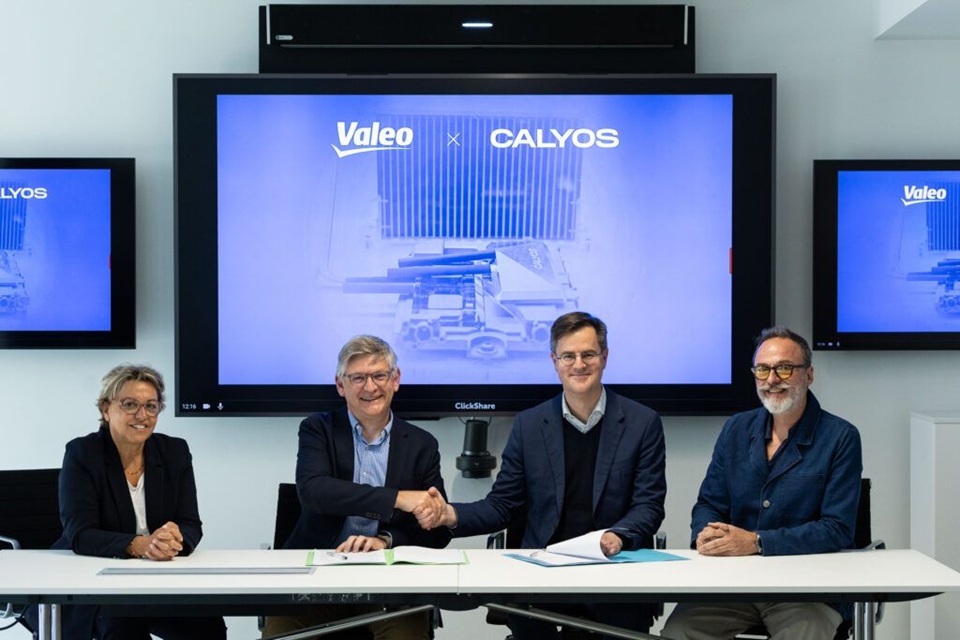
Valeo, a world leader in automotive technology, and Calyos, a pioneer in passive advanced two-phase Loop Heat Pipe (LHP) cooling solutions, announce the signing of a Memorandum of Understanding (MoU). It aims to develop and industrialize high-performance, standalone chip cooling solutions for the mobility and computing sectors, addressing the increasing thermal challenges posed by electrification and Artificial Intelligence (AI).
By combining Calyos’ expertise in Loop Heat Pipe technology with Valeo’s world-class thermal systems engineering, industrial scale, and global footprint, the two companies are set to deliver a new generation of passive advanced two-phase cooling systems that are more efficient – managing high heat flux – are more compact and easy to integrate, are maintenance-free, and highly reliable.
As the scale of automotive electrification continues to grow, together with Software-Defined Vehicles (SDV), the computing power and heat generated by power electronics are increasing exponentially.
Xavier DUPONT, Valeo Power Division Chief Executive Officer, stated: “This cooperation with Calyos is a new step in our mission to lead the thermal management revolution. By integrating Calyo’ s Loop Heat Pipe expertise into Valeo’s industrial ecosystem, we provide our customers in both the automotive and data center sectors with a unique cooling solution that is easy to integrate and scale, while significantly enhancing energy efficiency to support a more sustainable future. This new technology is a perfect add-on to our existing portfolio of thermal management solutions for data centers and vehicle power electronics.”
Antoine DE RYCKEL, CALYOS Chief Executive Officer, and Olivier DE LAET, CALYOS founder added: “Partnering with Valeo allows us to take our technology from a specialized innovation to a global industrial standard. Valeo’s manufacturing prowess and thermal expertise are the perfect catalysts to meet the cooling demands of the AI era and the next generation of electric vehicles.”